


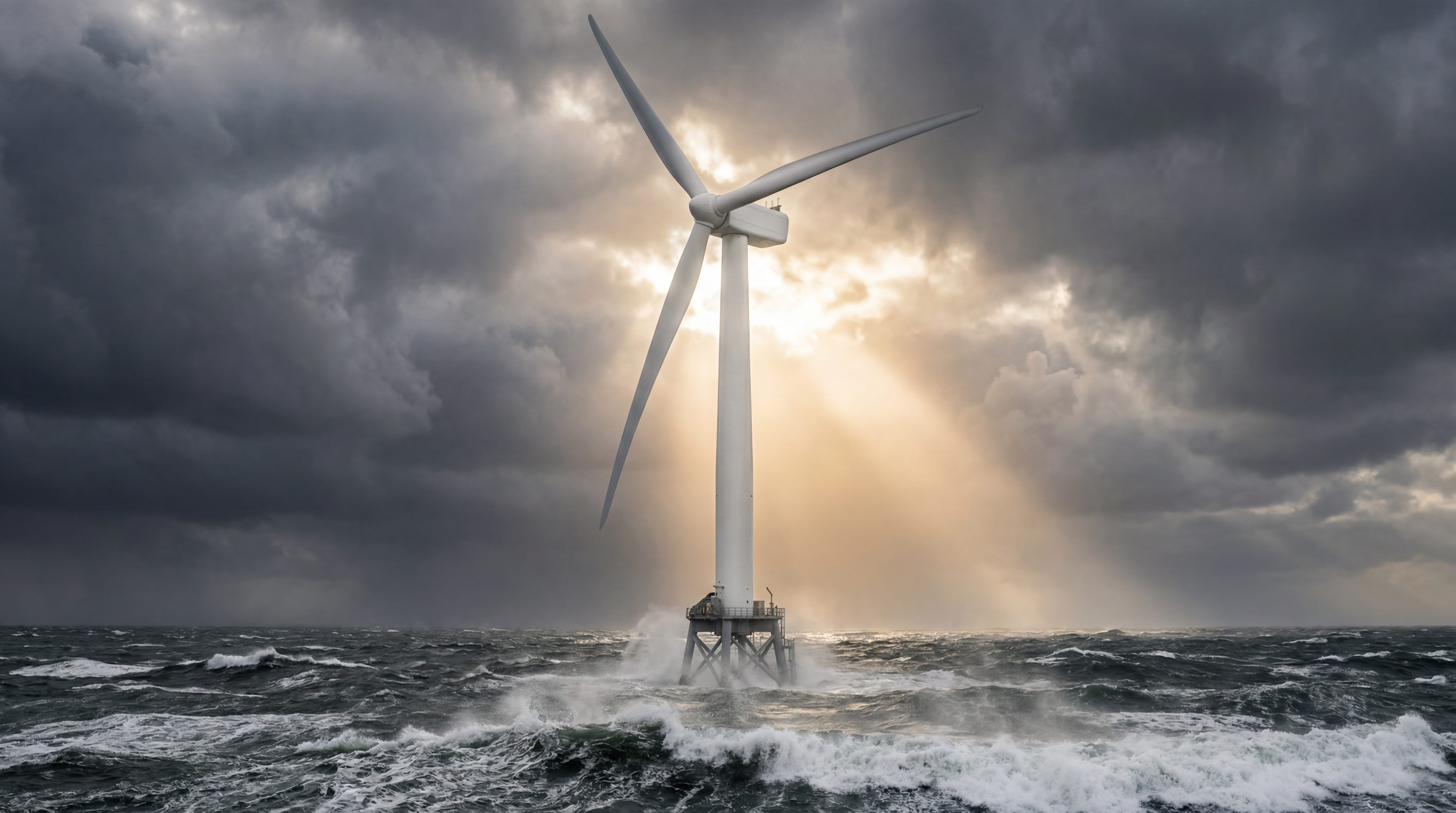
The UK government announced an electricity market reform that successive governments have ducked for a decade. From next year, legacy low-carbon generators will be moved, voluntarily but under Treasury pressure, onto fixed-price contracts and off the gas-linked wholesale price. This covers roughly a third of UK power and was long overdue. It is one of three reforms required. The other two are: to synchronise renewables build-out with grid expansion delivery pace; and to diversify supply with firm, dispatchable low-carbon gas power+CCS generation alongside renewables, and small modular nuclear reactors.
UK wind is a crown jewel. Wind overtook gas in 2024 as the UK’s largest source of electricity, at about 30% of generation against gas at 26%. Carbon intensity hit a record low of 124 gCO₂/kWh in 2024, down from 419 gCO₂/kWh a decade earlier. Chris Stark’s Mission Control, working with NESO, has rationalised the grid connection queue from over 700 GW of speculative applications to 283 GW of shovel-ready projects, of which 132 GW align directly with the Clean Power 2030 target. That is real progress, moving electrical mountains at rapid speed.
DISTRESSED BUYER
Chris Stark is right that a target drives concerted action. I would add from thirty years of experience that a target has to be resilient over time, or it erodes stakeholder trust. Inflexible targets that force bad procurement decisions cost more than minimal delays avoided. There are signals that the government got this wrong with the AR7 auction.
The seventh Contracts for Difference (CfD) allocation round closed on 14 January 2026. The press release lauded 8.4 GW of offshore wind secured, cleared at a strike price of £91.20/MWh for fixed-bottom wind projects. That is around 11% above AR6 on a year-on-year basis, and closer to 26% higher when you normalise for the shift from 15-year contracts in AR6 to 20-year contracts in AR7. The auction structure itself signalled something had gone awry. Unconsented projects were allowed to bid and win for the first time, a deliberate relaxation to widen the pool. The auction budget doubled mid-process, from £900 million to £1.8 billion. Around 82% of capacity went to a single German utility, RWE. Along with its project partners, RWE won 6.9 of the 8.4 GW.
82% of an auction round concentrated in one company is excessive single-company risk for a system that depends on the build-out completing on schedule. The Ørsted Hornsea 4 halt in May 2025, the loss of about 5% of the 2030 offshore wind target at the time, is the concentration risk made concrete.
Read those AR7 signals together, the relaxed eligibility, the doubled budget, the dominant single winner, and you see a government that bidders sensed was a distressed buyer, bound by its manifesto promise and the fear of the AR5 auction, which received no bids. Distressed buyers pay premiums.
Procurement failure was dressed up as climate ambition but consumers will carry the high costs for twenty years. More worrying still is that high strike prices are now anchored. Legacy wind operators with contracted prices at half this level will be rubbing their hands at the prospect of new fixed-price contracts offered to them.
CONGESTED GRID
Meanwhile, the grid cannot absorb what has already been contracted. Transmission constraint costs reached around £1.9 billion in 2024/25. Around 98% of curtailed and stranded wind is in Scotland, because the cross-border transmission capacity into England is a bottleneck. About £350 million of that £1.9 billion was paid directly to Scottish wind farms to switch off, and the CfD top-up makes the wind farm whole against its strike price regardless. Consumers fund both sides of this wasteful trade. NESO projects the bill will rise to between £4 billion and £8 billion a year by 2030.
A reader in Stonehaven commented to me that he was looking out at seven wind turbines from his home. Five were turning slowly, two still. Stonehaven was where my favourite model train shop was when I was a boy. Those miniature engines may be why I became an engineer. They ran on electricity. I explained to the reader that the turbines are not broken. The grid is full. The wind blades are paid to stand down because the wires to England are congested, and the wind farm gets paid either way.
Which brings us to the speech given by the Energy Minister, and the latest conflict to create an energy shock. The war in the Middle East has reopened the question that shaped UK energy policy after Ukraine: how exposed are British household energy bills to global events they have no control over? This is the second such shock in less than five years. The Chancellor’s statement to the Commons framed the package as a direct response to that. Ed Miliband’s speech to the Good Growth Foundation framed the delinking reform as structural, not just immediate.
STRUCTURAL REFORM
Energy Minister Miliband and Chancellor Reeves are right that there is a structural distortion at the heart of the UK electricity market. Volatile gas prices usually set the wholesale price of electricity. Miliband explained that around 90% of the time in the early 2020s, the marginal price-setting plant on the grid was a gas turbine. This meant wind, nuclear and other low-carbon generators received the gas price for their output even though their own costs had nothing to do with gas. Today, Miliband told the Good Growth Foundation audience, gas sets the price around 60% of the time. The government expects that to fall to about half the time by 2030, as more firm low-carbon generation comes online. This is all positive progress.
The Treasury’s move is the piece that makes the structural reform bite. The Chancellor raised the Electricity Generator Levy rate from 45% to 55% with immediate effect and extended the levy past 2028. The rate rise is calibrated to make the new Wholesale Contracts for Difference (WCfD) more attractive to legacy low-carbon generators than staying on the gas-linked wholesale price. Take-up is voluntary. DESNZ will introduce WCfDs later this year with an allocation round in 2027. Together the generators in scope cover about a third of UK power.
I have watched this closely over many years. Almost every serious market economist and half the industry have been asking for a version of what the Chancellor announced. Congratulations are due. When I helped to originate the Net Zero Teesside industrial CCS cluster (and its gas power+CCS project) with David Eyton at BP, and many other allies, we recognised that UK clean power revenues eventually had to be decoupled from gas. Electricity has to be cheap enough to support the industrial electrification business case and the broader economy. This is the decoupling move. Successive governments have been told for a decade that the merit-order effect is the single largest source of avoidable bill pain. This one has done something about it. Good.
This is where we begin to diverge. Miliband’s speech cited AR7 as proof that renewables are around 40% cheaper than building and operating new gas. That figure relies on comparison to an unbuilt CCGT at a load factor that would never be financed, and it excludes the cost of getting those electrons to demand.
MARGINAL GAINS
The Minister borrowed the British Cycling Team philosophy during his speech to describe the marginal-gain approach to clean energy infrastructure. A great metaphor. But the marginal gain that matters most right now is not another gigawatt of generation contracted. It is another kilometre of overhead line energised, another substation commissioned, or cross-border subsea cable laid.
Reforms announced on land access, permitted development rights and self-build grid connections help. They will not make the grid accelerate to keep pace with AR7, let alone AR8 and AR9. And while we debate the queue, the AI data centres that could be anchored on cheap Scottish wind are moving to Ireland and the Nordics. The government cannot see the electrification and AI wood for its Clean Power 2030 trees. Affordable electricity, not wind energy, is the priority. Cheap electricity will electrify our homes, cars and industries much more than overpaying stranded Scottish wind turbines to do nothing. This is common sense.
THREE SUGGESTIONS
Three components of the delinking package will decide whether bills fall or climb for twenty years.
The first is negotiation mechanics. A legacy generator will only switch to a voluntary WCfD if the fixed price leaves it at least as well off as staying on wholesale minus the 55% Electricity Generator Levy. The current second fossil-fuel shock in under five years anchors the price. The Treasury is a distressed buyer, bound by its promise to cut bills by November, and the generators know it. Distressed buyers pay premiums. This is what cleared AR7 at £91.20/MWh. A fix would be to index the WCfD strike to long-run marginal cost plus a fair return on capital still invested, and let Ofgem adjudicate the formula rather than the Treasury negotiate a fixed outcome.
The second is instrument shape. The Electricity Generator Levy taxes windfalls when they happen and disappears when they don’t. It is shock-responsive, the right shape for a decade of perma-crises. A WCfD is the opposite. It pays a fixed price for twenty years whatever wholesale does, insulating the generator from risk and locking the consumer into one price for two decades. The danger is that the scheme reprices the cheapest third of British electricity up towards the AR7 strike of £91.20/MWh. Wind energy for consumers is not cheap in this market. The fix here is to cap any new WCfD with a floor and a ceiling around the strike so both sides carry some risk and neither locks in the extremes.
The third is policy credibility. Raising the EGL on revenues generators are still earning is a change in the rules mid-flight. A scheme described as voluntary but engineered through tax pressure looks like coercion to investors. Investors may demand a premium for that uncertainty in the next auction. Not all legacy generators face the same risk profile, and the scheme needs to reflect that. The LNG glut expected in 2026 may reduce gas prices significantly, leaving consumers paying a premium above a falling wholesale price. It would be wise to build in break clauses or a ceiling that shares that downside with bill-payers, without conceding the upside of a low wholesale price to the generator.
Negotiated well, households will avoid higher bills the next time fossil fuels spike.
Negotiated badly, generators lock in a premium for two decades, AI and wider electrification are not viable, the Treasury loses the windfall tax line it is currently raising, and consumers pay twice: a higher fixed strike price on every bill, and the loss of the windfall clawback that used to come back to them.
My balanced summary is this. The delinking announcement is the right move, and successive governments have ducked it for too long. Clean power generation does not drive grid expansion. We are still spending to turn clean power off. Those outcomes are not derived from generation alone. We must be wary of distressed buyer behaviour forced by short-term targets. There are more levers to pull. Grid transformation, zonal pricing, conditional LDES investment, much to explore. That said, credit is due. There is much to praise. Market reform has arrived at last.
INSIGHTS
The delinking announcement is the electricity market reform the UK has needed for a decade. Today, 60% of the time, the price of electricity is driven by the price of imported gas when a third of UK electricity comes from legacy low-carbon generators whose costs have nothing to do with gas. As a result, wind operators earn windfall profits in crisis periods, which the 2022 Electricity Generator Levy partially claws back. Wind energy is not cheap in this market. The Chancellor extended the EGL beyond 2028 and raised the EGL from 45% to 55%. This is to push legacy generators to move voluntarily onto fixed-price Wholesale Contracts for Difference from 2027.
If the strike prices are negotiated well, households will see lower bills the next time a fossil fuel shock hits. If they are set badly, the Treasury loses both ways: forgone EGL revenue today, and higher bills to defend at the next election. A well-designed scheme would index the WCfD strike to long-run marginal cost plus a modest return on amortised capex, publish floor and ceiling bands, and put the negotiation under independent adjudication. The risk is that the scheme reprices the cheapest third of British electricity up towards the AR7 strike of £91/MWh for twenty years, trading the cyclical EGL insurance policy instrument for a fixed premium. The detail of contract negotiation will matter more than the announcement. The AR7 negotiation set a worrying precedent. But market reform is directionally right.
The 40% figure Miliband cites to describe AR7 against new gas is misleading, because new CCGTs will not be financed at a 30% load factor. New gas like NZT Power will be over 90% clean gas power+CCS plants at £86–94/MWh with shared transport and storage costs included. Gas+CCS is not subject to heavy carbon price penalties and is not intermittent like wind. Gas would require prudent hedges: explore our own North Sea gas; secure long-term deals with Norway and Qatar; and expand UK gas storage. Equinor (an NZT Power partner) and Qatar LNG will likely welcome long-term contracts because prices will fall with a near-term global glut of new LNG production predicted from 2026 onwards.
Miliband obscures the true cost of wind. We must include grid infrastructure costs to move electrons from generation largely in the north to demand in the south. Transmission constraint costs reached around £1.9 billion in 2024/25 and direct payments to switch Scottish wind off ran to around £350 million of that. About 98% of curtailed and stranded wind is in Scotland. The constraint bill is projected by NESO to escalate to £4 billion to £8 billion a year by 2030. A clean electron that cannot reach demand is not a cheap electron. And yet, applying zonal pricing, Scottish electricity could be among the most competitive in Europe and attract growth industries like AI.
A grid-first pivot alongside price delinking is sound industrial policy. The decisions that matter next are not about hope, as Miliband said in the questions after his speech. Hope is not a method. The decisions are about sequencing. We must synchronise AR8 and AR9 with grid delivery. It is also wise to diversify bidders in future CfD rounds to protect the system from another Ørsted episode. Let firm, dispatchable low-carbon do the work that intermittent generation should not be forced to do on its own. This includes several more gas+CCS projects where the supply chain and skills already exist. Keep accelerating the Great Grid Upgrade’s 17 projects and the 35 schemes in NESO’s Beyond 2030 plan. Build subsea HVDC corridors that link Scottish wind to English demand, and ensure that the Royal Navy can defend them. Keep working the LDES toolkit to cut curtailment and capacity costs. Set zonal pricing to reward locations, not strand them. Clean Power 2030 will be judged by household bills. Delinking helps, as do wires and faster connections. Sensible sequencing and a commercial mindset help most of all.