


No energy transition has ever unfolded as planned. Nuclear was going to make electricity too cheap to meter. The US shale revolution wasn’t in any credible forecast. Solar left every official projection looking timid within years of publication. Each reworked the energy landscape; none followed the script.
The current energy transition is no different. The unexpected is to be expected.
The UK’s 2023 offshore wind auction attracted no bids, not because the technology had failed, but because costs had moved beyond what the policy framework assumed.
The energy transition has surfaced a dependency that most scenarios hadn’t modelled: solar panels, batteries and wind turbine magnets are all manufactured through supply chains dominated by a single country. Diversifying energy sources turns out to require first diversifying supply chains.
Then there was AI. ChatGPT launched in November 2022, and within months Microsoft, Google, Amazon and Meta had committed hundreds of billions to new data centres. An electricity demand surge that almost no transition scenario had modelled was suddenly underway. The limit to the AI revolution will not be Nvidia chips: it will be the ability to power them.
The energy transition is happening. Just not the way anyone planned.
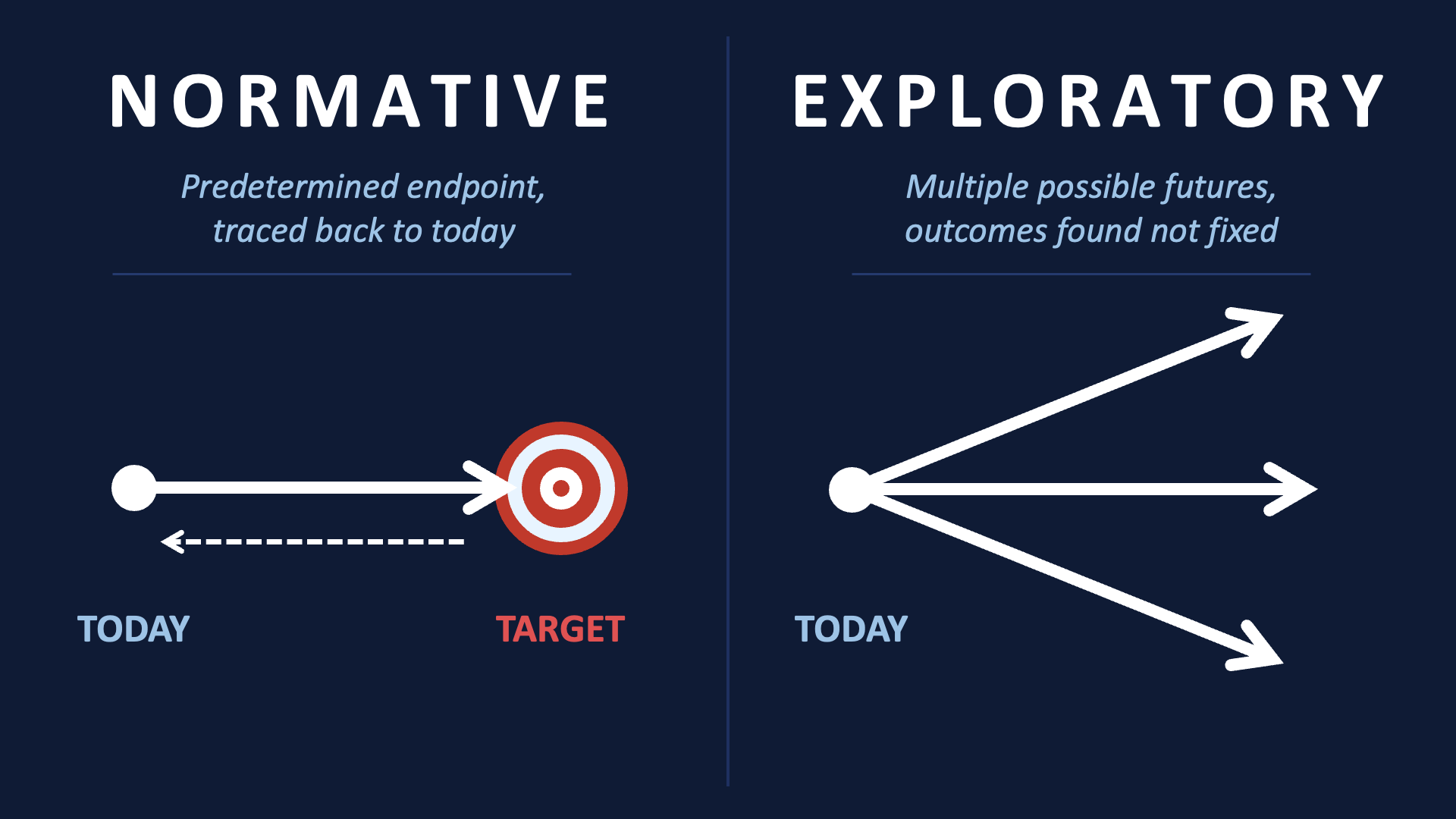
The dominant mode of transition planning is normative: start from a desired end-state and work backwards. This is useful for setting direction. But a normative scenario that turns out to be wrong is not just unhelpful; it is actively misleading. It directs capital, policy and infrastructure towards assumptions that may never materialise, while crowding out the harder, more honest question: what if it doesn’t go to plan?
The 1.5°C target is the clearest example. The EU’s Copernicus data has confirmed what the trend lines had been signalling for years: the threshold is already being crossed. This was always the likely outcome of a normative target derived from a politically negotiated endpoint rather than from a range of plausible energy futures. That does not make the underlying ambition wrong. Reaching net zero before this century ends remains within reach. But the path there will not be the one the target prescribed.
The more useful frame is exploratory: not a predetermined endpoint, but a set of possible futures and strategies that hold their value across more than one of them.
Shell’s scenario set is instructive: alongside their normative net-zero pathway, Archipelagos maps a fragmented world of geopolitical tension and uneven transition; Surge is shaped by AI demand and rapid technology deployment. Both look considerably more like the world we are actually in.
The World Energy Council’s 2025 review reinforces the point: AI demand, critical mineral dependencies and affordability pressures remain underweighted in most normative models.
The answer is not a better normative scenario. It is a different kind of planning altogether, one that holds multiple exploratory futures simultaneously, tests strategy against each of them, and resists the temptation to pick a winner.
One normative scenario, however well-constructed, is not a strategy. In too many organisations, it has become one.
INSIGHTS
Ukraine and Hormuz didn’t arrive without warning. They arrived without sufficient preparation. The Strait of Hormuz has featured in IEA energy security analysis for decades. Europe’s structural dependence on Russian gas was documented years before February 2022. The question was never whether the risks were known. It was whether organisations had stress-tested their strategy against them. Most hadn’t. The same pattern runs through every major energy disruption of the past decade. The UK’s 2023 offshore wind auction design flaw halted an entire deployment cycle; the risk of policy-cost misalignment had been visible for years. Chinese dominance of solar panels, batteries and wind turbine magnets was not invisible to analysts. It was deprioritised because cheap manufacturing was the fastest path to deployment, and resilience was a problem to solve later. A single commercial AI product rewrote global electricity demand projections within eighteen months of its launch. None of these were outliers.
The 2008 financial crisis arrived without a mainstream forecast. What followed quietly rewrote the economics of the energy transition. Near-zero interest rates and quantitative easing ran for over a decade, making transition capital look cheap on a cost of capital that now no longer exists. COVID compounded it: when China locked down, the world discovered that batteries, solar panels and rare-earth magnets were largely manufactured in a single country. Both shocks reshaped the investment landscape. The version of the energy transition that most organisations were planning for assumed stable geopolitics, cheap money and open supply chains. All three assumptions have been tested. None have held.
Shell’s scenario planning gave it a competitive advantage in 1973, not because it predicted the oil shock, but because it had already considered comparable futures before the crisis arrived. Most organisations have not followed, because scenario thinking does not produce a single answer and boards need a single number. The confusion runs deep. The IEA calls the World Energy Outlook 'the most authoritative source of global energy projections' and 'a scenario-based approach' — both terms on the same page. These are not the same thing. A projection implies a most-likely outcome. A scenario is one of several plausible futures, designed not to predict but to test. They reach for the projection without engaging with the scenario. What they need is not a better projection. They need scenario thinking: holding multiple plausible futures and testing strategy against each of them, rather than reaching for a single number.
Responsible Energy Briefing: When molecules can't move — examines the physical infrastructure constraints that make exploratory scenario planning essential. Free to read.
The central thesis of this commentary seems to be normative energy transition models, which backcast from a desired end-state like the 1.5°C target, are fundamentally unsuited for navigating actual energy markets because they fail to accommodate exogenous structural shocks. Recent disruptions underscore this systemic blind spot, notably the sudden exposure of concentrated critical mineral supply chains, the rapid shift from cheap capital to a high-inflation environment, and the exponential surge in data centre electricity demand triggered by AI deployment.
Rather than treating these events as statistical anomalies, institutions must pivot from deterministic projections to exploratory scenario planning. While projections imply a single, high-probability outcome, scenarios function as tools for stress-testing strategic resilience across multiple plausible futures. True strategic competence requires holding multiple exploratory outcomes simultaneously and resisting the institutional urge to manage toward a single, politically convenient number.