


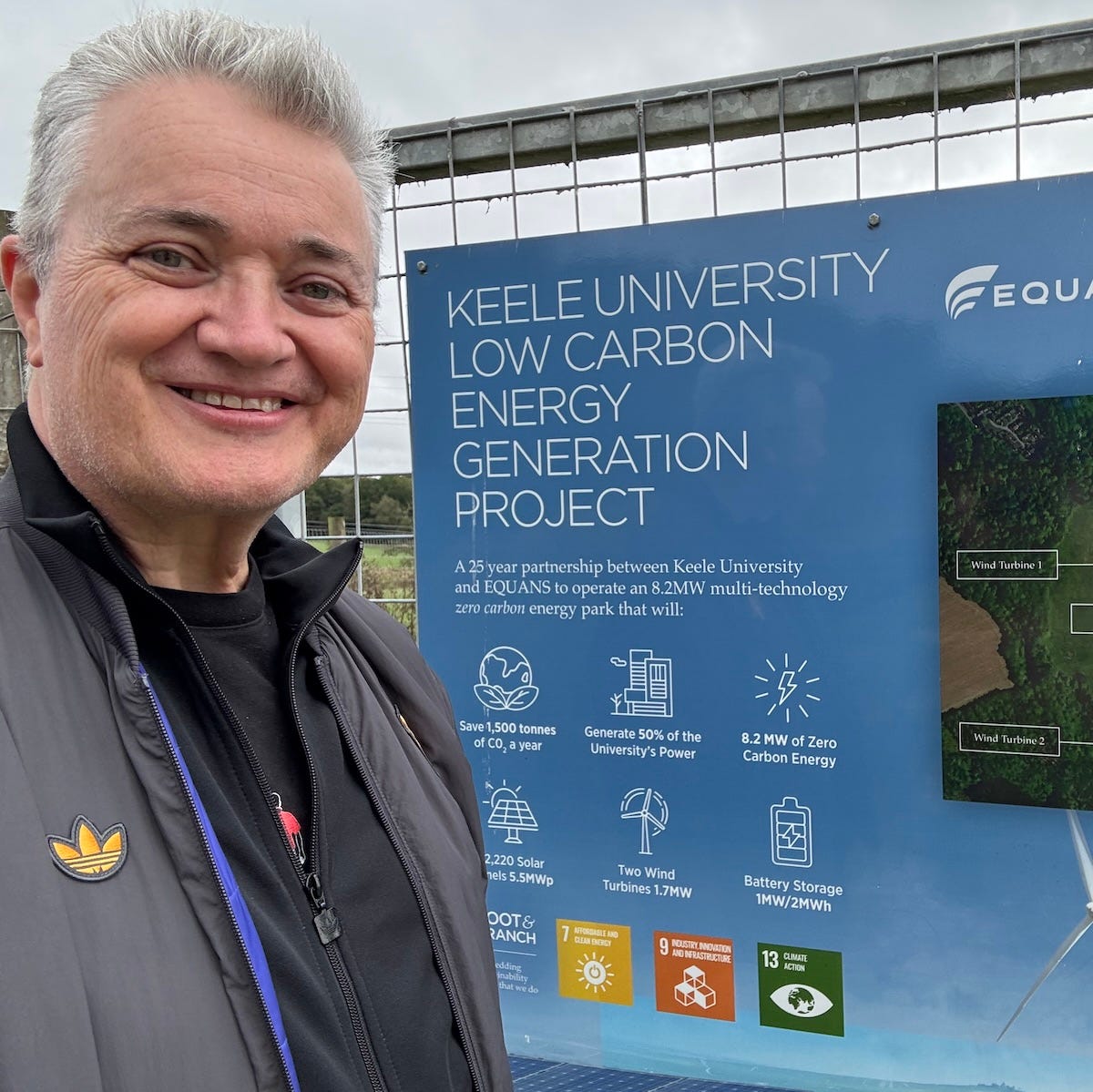
Keele University gets half its electricity from the clean energy park in the photograph above, at a price fixed in real terms for 25 years. Adura’s Jackdaw gas project will produce for less than half that time, and be abandoned long before 2050. The UK energy transition needs both.
Keele has 8.2MW of solar, wind and battery storage on one site, financed by EQUANS against a fixed annual fee from the university. It had no Contract for Difference, no Renewables Obligation and no Feed-in Tariff. The wider Smart Energy Network Demonstrator it sits inside did take ERDF and BEIS money. The 8.2MW of generation did not. Commercial models work for clean energy.
That is the renewables contribution to the energy transition: a secure generation and storage system that hedges imported supply risk and price spikes. It is an argument already won, when the pace and the contractual terms are affordable. Unlike AR7, which cleared offshore wind at £90.91/MWh in 2024 money, even higher than AR6 in real terms. Firming up intermittency will add further expense. Energy professionals know that the pace of investment has to match supply chain capacity. Build too quickly and the supply chain overheats. Costs spiral.
It is counterintuitive to tackle rising temperatures by making clean energy prohibitively expensive. We need cheap UK electricity to boost demand and electrify the economy.
The other energy transition contribution is our own North Sea oil and gas. Westminster is still deciding on Jackdaw, with Rosebank behind it. It is a no-brainer to approve both, and other UKCS fields. We still import oil and gas. Jackdaw will displace typically higher carbon LNG. Rosebank oil and gas will be produced at lower carbon intensity than most imports, and protect valuable jobs. We need the tax revenues too, with national debt approaching £3 trillion.
Nearly 600 experts have written to the Prime Minister to express concern about Rosebank. Yet, we are often reminded that the North Sea is a declining basin. Let the geology and economics set the decline curve. Jackdaw’s own environmental assessment has it ceasing production by 2037 in every case. It will land well before 2050 without any ministerial intervention. Professor John Underhill is spot on: we should not be importing insecure, higher carbon oil and gas, or exporting UK jobs, when we have the North Sea on our doorstep. How do successive UK and Scottish governments keep dropping the ball here?
Net zero is becoming a politically toxic term because loading costs onto bills has not reduced global emissions. I sat in UN COP climate rooms. Economic self-harm does not buy the UK influence (or attract AI data centres). We need course correction to set the right pace, and transition affordably. Energy security is real. Climate impact is real. The grown-up debate is about timing and cost. Responsible energy transition must be secure, affordable and ideally profitable. Not ideology. Arithmetic.
INSIGHTS
A contract beats a pledge. Keele’s park was financed because a university signed a 25-year fixed fee, not because a minister announced a target. Capital follows revenue certainty, and clean power in this country gets built where that certainty exists.
Pace is a cost lever, not a virtue signal. AR7 came in well above AR6 in real terms despite falling technology costs. When the build programme outruns the supply chain, the price is set by scarcity, and the UK electricity bill payer funds it. Bidding utilities can also leverage the government’s self-imposed targets to drive up auction prices.
A declining basin does not need a ban. Jackdaw stops producing by 2037, on its own numbers. The debate about North Sea approvals is a debate about the next decade, not about 2050. Climate objections to North Sea oil and gas projects make little sense while the UK is importing LNG from Qatar and the United States.
Responsible Energy Briefing: Not ideology. Arithmetic. A 25-year clean power contract, an 11-year gas field, and the grown-up debate about energy transition timing and cost. Free to read.