


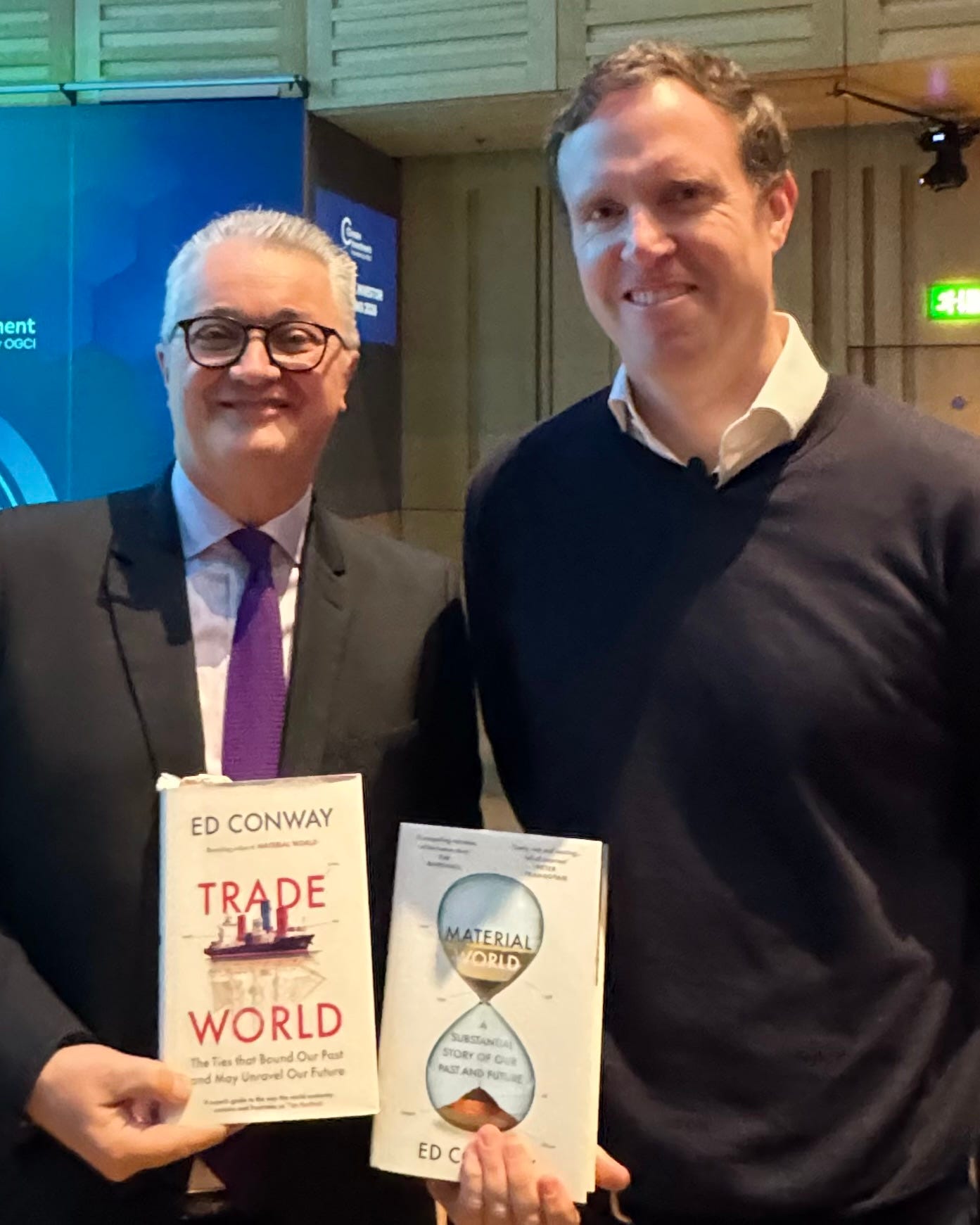
Almost every solar panel on earth depends on quartz from one small town in North Carolina. Ed Conway told the Climate Investment investor day that Spruce Pine supplies the near-perfect quartz for the crucibles in which the world’s silicon is grown. It is the cheapest and most convenient source. That is, until you notice that all the eggs are in one basket.
Hormuz and other choke points are far more common than we might imagine. Joshua Haacker, chief investment officer at Climate Investment, interviewed Ed on the patterns in Material World and his new book Trade World.
Both books are brilliant. I read Material World when it first came out, which tells the substantial stories of sand, salt, iron, copper, oil and lithium, how they built our world and how they will transform our future. I also read Ed’s Substack on the topics which contributed to his new book Trade World. It is a great read and very timely.
I love the way Ed weaves together history, personal stories, and explains technology and processes so that anyone can understand them.
Three things I took away for executive teams and boards:
The energy transition is a rethink of industrial processes unchanged for 200 years: steel, cement, chemicals, even the coal still used to make metallurgical silicon. The challenge is enormous but so is the opportunity. Secular low-growth stagnation is not the real story. Transformational industrial revolution is ongoing.
Better products win, not worthier ones. An electric motor uses about 80% of its energy; a combustion engine wastes that much. LEDs beat tungsten. Josh’s test for every investment is a positive return that also cuts emissions, because it has to make sense to the customer.
Trade adapts faster than policy. When sanctions cut car exports to Russia to zero, exports to its neighbours rose. Tariffs on China divert trade via South East Asia. Supply chains adapt like living networks. The bottleneck is most often politics, not technology, capital or permitting.
Like most of us, I click a shopping button and the item arrives. Ed’s books made the many physical processes and trade networks behind that click visible to me for the first time.
How many of us realise that coal is used to extract from quartzite the pure silicon that goes into most solar panels? Carbothermic reduction is so hot that workers need to wear those special heat resistant suits that make them look like spacemen.
Many industrial processes rely on carbon chemistry. As one reader put it in reply on my LinkedIn post, we tend to focus on decarbonising the energy supplied to established industrial processes, but sometimes the larger opportunity is to reconsider the process chemistry itself. This is certainly true of steel and cement manufacture. Global industrial emissions reduction cannot be solved by renewable energy alone.
I also share Ed’s view that it is rational to be a techno-optimist. The data on living standards since the Luddites leaves little room for doubt. More optimism helps. Fear of AI or climate change should not crowd out our curiosity to invent a more sustainable and affordable future. Ed’s books and videos help understanding of interconnected value chains and modern processes, making the invisible more visible.
Which process in your own company needs to be rethought before it is disrupted?
INSIGHTS
The cheapest and most convenient source is also a concentration risk. Spruce Pine won on price and purity. An executive team that watches only costs, driven by the bottom line, may not see the choke point until it has closed tight. That said, trade networks are highly adaptable to rapid changes.
The carbon is in the chemistry, not only in the energy. Metallurgical silicon is made by reducing quartz with coal. Clean power to the furnace will not remove carbon. Reducing iron ore to make virgin steel is the same. The bigger prize is a different process. Hydrogen works for direct reduction, which moves the byproduct from CO2 to H2O.
The customer applies Josh’s test anyway. Electric motors and LEDs won because they were better products. An investment that cuts emissions and earns a return does not have to persuade the buyer on virtue. If we had started with EVs, people would think we were mad if we proposed to take them away and replace them with a slower, noisier, dirtier petrol engine vehicle that wastes 80% of its energy.
Trade routes around policy. Sanctions and tariffs redirect flows through neighbours rather than stopping them. Plan for the network to adapt, and for politics to remain the bottleneck. Most of the energy and trade shocks today are driven by geopolitics.
Responsible Energy Briefing: When molecules can’t move. Free to read.