


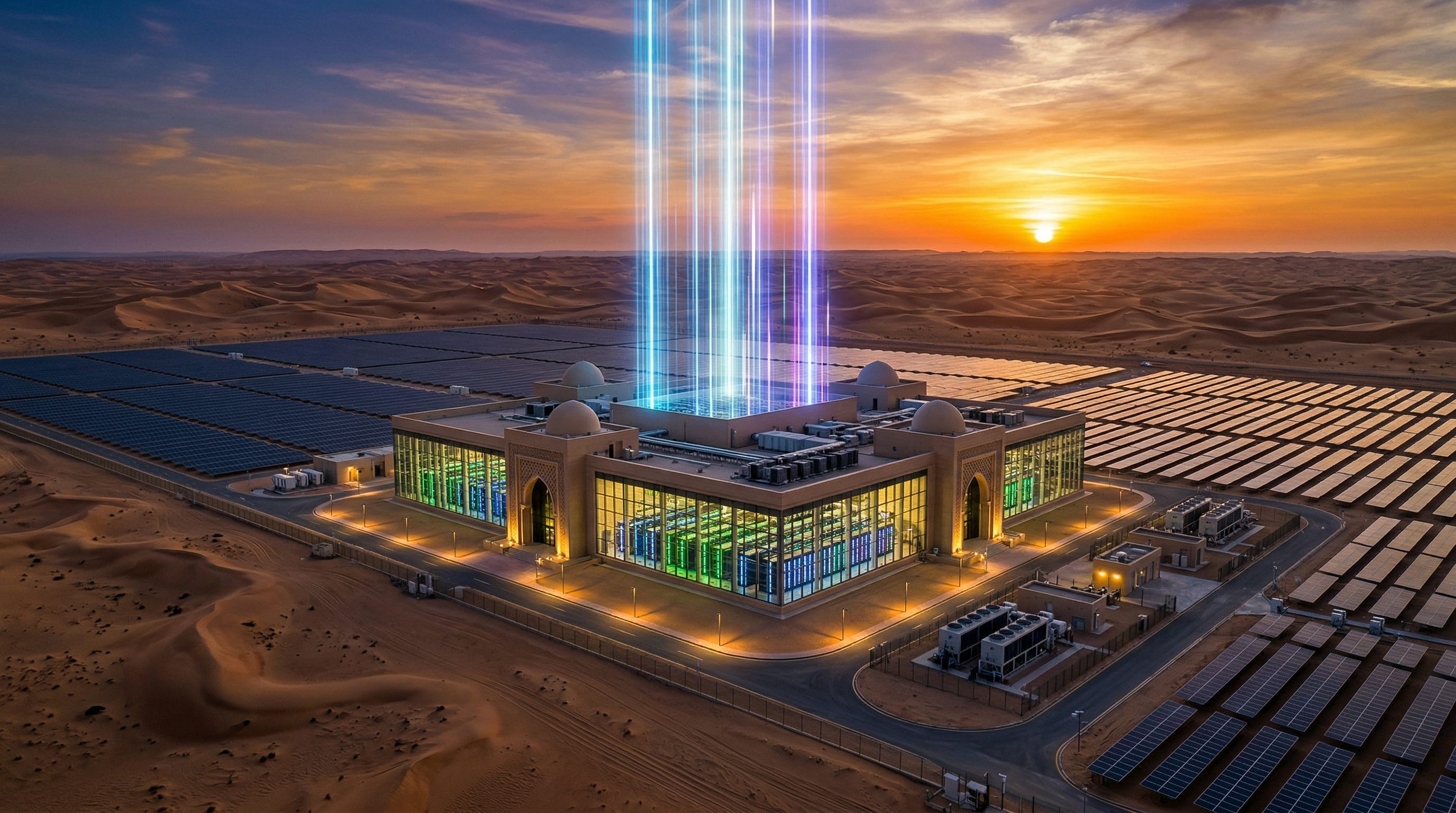
AI superpowers source the cheapest electricity. Gulf states recognise this, and the UK and Europe must compete. The US and China are ahead in the AI race. The US leads on chips and frontier models, and is energy independent. China is first on the podium of electro-tech roll-out. China State Grid spent a staggering $11 billion on infrastructure in the first two months of 2026. The AI economy race is becoming an electrification race. Generate cheap, abundant electrons and you can power more Nvidia chips than rivals.
When I was working for ADNOC Group, I sat in a glass tower overlooking the diamond blue Arabian Gulf below. One day a senior peer coached me that a ‘green halo’ was not a convincing argument to drive investment in clean energy. As I looked out at the sun-sparkled sea, I appreciated that I needed to reframe energy transition around the benefits of refining solar photons, not oil. The most compelling argument for energy transition is commercial. You exploit lowest cost feedstock (free photons), refine highest margin product (AI tokens), and use resources (land) you already own.
The Gulf is building a vertically integrated AI economy. Low-carbon solar photons will power its AI refineries for compute. Clean energy is incidental to the investment case. It just has to be cheap. Saudi Arabia’s Al Shuaibah solar project costs $0.01 per kilowatt-hour. Compare that to UK offshore wind, Britain’s primary clean power bet. January’s AR7 winning bids were eleven times the Saudi solar price. Of course, such deliberations should include the value of having secure local AI infrastructure and keeping certain data private nationally. Offshore wind has fewer permit hurdles or environmental protests seen with onshore wind. There are nuances beyond cost.
Gulf nations have related structural advantages that most European policy cannot easily copy. GCC countries have tracts of state-owned desert land, and patient capital from Gulf wealth funds that European project finance cannot match. Affordable, available land in New Mexico helped solar and wind capacity increase by 40%. On the Arabian Peninsula, there is abundant state-owned land and fewer planning and market barriers than in the US.
The Emiratis are investing in British offshore wind. Abu Dhabi’s Masdar co-invested €5.2 billion in East Anglia THREE, one of the UK’s largest offshore wind projects. It holds a 49% stake in the £11 billion, 3 GW Dogger Bank South development. The UAE will receive UK Contracts for Difference (CfD) payments about six to eleven times higher than its own domestic generation cost. These high energy prices are locked in by CfDs until 2045. Masdar understands the spread.
Our talent is the other prize for overseas investors. DeepMind was bought by Google. Darktrace cybersecurity was taken private by US Private Equity. Japan’s SoftBank acquired ARM Holdings. It will not only be petroleum engineers and exploration geologists coveted in the UAE, but also the best AI modelling entrepreneurs and advanced computing talent. We may also lose talent if alluring tax havens start to offer expats cheap access to AI tokens. The energy cost numbers compound. If the compute layer migrates to $0.01/kWh electricity and the UK’s contracted offshore wind price is up to eleven times that, European AI inference costs will be structurally higher for decades.
I still have my ADNOC lapel pin, black enamel with gold-lettering, celebrating fifty years of extracting oil, refining it, and exporting the product that powered the world economy. The Gulf countries are applying the same model in a new form. The new commodity is photons refined into AI tokens. Saudi Arabia’s NEOM has already pivoted to a $5 billion net-zero AI data centre cooled by Red Sea seawater.
AI and photons are not stopped by the Strait of Hormuz chokepoint. Data moves at the speed of light, not the speed of an oil tanker, and can be beamed via satellite.
The UK and Europe are responding. The EU will mobilise €660 billion annually to catalyse clean energy investment with a new Energy Transition Investment Council. Data centre investment in Northern Spain has surpassed ~$90 billion. Meanwhile, the UK has its AI Opportunities Action Plan. DeepMind continues to anchor London’s AI ecosystem and OpenAI announced it is establishing its UK office nearby. France has developed its Mistral frontier model. The talent to build the AI model layer is not the constraint.
Electricity cost is the constraint. The AI compute layer will relocate to other regions if the UK and Europe cannot compete with $0.01 per kilowatt-hour. Skilled engineers may move too if they are offered better pay, expat lifestyles, and other assurances.
INSIGHTS
OpenAI’s decision to pause its UK Stargate data centre project is the clearest signal yet that electricity economics are a binding constraint on AI infrastructure. OpenAI announced its first permanent London office this week. It will have the capacity for 500 staff and will be its largest research hub outside the US. On the same day, the company put on hold its data centre project, citing energy cost and the regulatory environment. The talent is staying but the compute is not. This is not a vote of no confidence in Britain’s talent or institutions. It is a vote of no confidence in Britain’s electricity price. The AI model layer and the AI compute layer are separating geographically. That separation may eventually lure some of the talent away too.
The Gulf’s energy advantage is not limited to solar. The UAE’s Barakah nuclear plant, built with South Korean expertise, comprises four reactors at 5.6 gigawatts. It reached full operational capacity in September 2024. The capital cost was approximately $5,700 per kilowatt, compared to Hinkley Point C’s estimated $11,800 per kilowatt. The UAE built twice the nuclear capacity for the same money. I advised on the first nuclear/solar credits sold to ADNOC to decarbonise its Scope 2 emissions.
Nuclear together with solar gives the Gulf diversified, ultra-low-cost electricity at a speed and cost with which most of Europe may struggle to compete. But Europe does have strengths, if it can concoct the right economic formula. Norway’s hydro-power and sovereign wealth funds are an example. Countries like Spain have growing industrial solar, and interconnections with North African renewables may offer hybrid potential. France is already a nuclear powerhouse. UK offshore wind is a crown jewel.
Sovereign wealth funds are the largest category of state investor in global AI. SWFs invested $66 billion in AI and digital infrastructure in 2025. The Norwegian SWF (the world’s largest) invests heavily in mega-scalers like Nvidia, Alphabet and Amazon. Gulf funds led overall, with 43% of all state-investor capital in the sector. Saudi’s HUMAIN has ordered 18,000 Nvidia Blackwell chips. Abu Dhabi’s MGX took a material stake in OpenAI. This is a deliberate strategy: build the cheapest electricity, attract the compute data centres, own stakes in frontier model leaders. The Gulf states are vertically integrating from photon to token across the AI stack.
Responsible Energy Briefing: When molecules can’t move examines the physical infrastructure chokepoints that define whether energy resilience is achievable. Free to read.