


What do women in energy need to progress? Eight years after researching the question, are we any closer to providing it? Careers can be a rollercoaster ride, and embracing the career squiggles in our work and family lives can be challenging.
Monica Collings OBE, Chair of POWERful Women coined the squiggle term when talking about her resilient and successful career. Someone who also navigated career squiggles successfully is my friend Rachel. Congratulations to Rachel Armstrong on a brilliant career which went from leading carbon solutions at Shell to shaping policy at DESNZ on carbon markets and industrial decarbonisation. I hope stepping back from the day to day means she might be persuaded to join a board. Rachel’s retirement and job moves by other talented women I know prompted me to revisit my own research.
In 2018 I completed my MSc dissertation at Henley Business School: “Coaching women to lead in the energy sector: an intersectional perspective on preferred strategies to overcome barriers to career progression.” I surveyed 215 women across 37 nationalities, using both quantitative analysis and open-ended questions. My supervisor Professor Dorota Bourne encouraged me to take an intersectional approach to examine how gender, ethnicity, years of experience, employment level and caring responsibilities all shaped women’s preferences.
TEN STRATEGIES FOR CAREER PROGRESSION
From the academic literature I synthesised ten strategies for career progression and asked women to rank them:
Mentoring and sponsorship
Networking
Confidence and knowledge of own strengths
Career development and stretch assignments
Career strategy and planning
Balance of career with caring responsibilities
Understanding corporate culture
Role models
Inclusive workplace and gender behaviours
Family and career balance
Most of those matter for anyone building a career, regardless of gender. But my research found that women in energy are disproportionately denied the most critical one: mentoring and sponsorship. They are left to rely on building self confidence instead.
Mentoring means someone advises you. Sponsorship means someone advocates for you when you are not in the room. Both came out as the number one preferred strategy, statistically significantly ahead of everything else.
Yet when I asked what had actually helped women in the past, the answer was building self confidence because they had to help themselves in the absence of structured support.
Needs also change across a career. Women in their first ten years valued confidence-building and stretch assignments most highly. Those with eleven to twenty years of experience valued balance significantly more. Caring responsibilities means not just mothers with young children, but elderly parents, relatives with disabilities or other needs, and the cumulative weight of being the person others depend on. But mentoring remained the number one need at every stage.
Almost half the women surveyed had used a coach, and almost all found it useful. Many described their coach as a kind of mentor. The roles blur in practice, and both serve the same underlying need: an independent trusted sounding board and counsel on career tactics.
85% of women said female colleagues had helped their careers. Many senior women who did not actively support others were not unwilling. They were often the only female leader in their organisation when they started, with no support structures of their own. You cannot pull someone up a ladder you are still clinging to alone. Building critical mass is part of the work that remains.
Positively, many senior women complimented the men who had mentored them. Male allyship is not a footnote. Allyship is essential, particularly when women are still so underrepresented at senior levels.
Gender was identified as the primary barrier above all other diversity dimensions. And when women described their biggest challenge in their own words, it was about workplace culture: being overlooked in meetings, excluded from informal networks where decisions are really made, and judged by different standards to male peers.
One respondent captured this perfectly: “I just don’t fit in their mental picture of how a technical leader looks. I have to work much harder to be visible.” Another reflected on feedback she had received to be “less assertive” and wondered whether she would have heard the same if she had been a man.
Confidence helped women survive that environment, but it was the environment itself that needed to change.
WHAT ADVICE WOULD YOU GIVE?
I asked 215 women: what advice would you give to a younger woman at the start of her career? Their answers still resonate eight years on.
On finding support: “Use mentors and sponsorships and plan ahead.” “Build a network to counter the very strong influence of the male network.” And, wisely: “Do not build your network to just build your career, build it on interest in people and their contributions and development.”
On self-belief: “Don’t be afraid of being yourself.” “Have confidence & challenge yourself: you set your own limits … be bold!” “Ring your own bell, as no-one else will.”
On critical mass: “Create powerful networks of women.” “Get more of you: get to a critical mass.”
On determination: “Do not give up, change is coming, and we need to be the ones driving that change.”
And on reshaping the workplace itself: “Don’t be limited by established ways of working, especially when it comes to juggling work and family life. Propose solutions that work for you and demonstrate that they work.”
EIGHT YEARS ON, WHAT HAS CHANGED?
When I was researching in 2016–2018, PwC reported that 62% of the top 89 UK energy companies had no women on the board. Only 1% of CEOs were women.
The latest POWERful Women / Bain & Company State of the Nation (2025) tells a more encouraging story, but with persistent gaps. Women now hold 30% of board roles, up from 29% in 2024. 8% of CEOs are women. But 20% of companies still have no women at board level at all. And in technical roles, women drop from 18% at entry level to just 5% at executive level.
Globally, the picture moves even more slowly. Women remain around 20% of the energy workforce (IEA). In oil and gas, 23%, up just one percentage point since 2020. In renewables, 32%, unchanged since 2019.
The pipeline from technical entry to executive leadership remains broken at exactly the career stages where mentoring, sponsorship and culture matter most.
Monica put it well recently: “resilience isn’t a personality trait, it’s a practice built over years.” She is right. The squiggle of a non-linear career is something to celebrate, not just survive. My research suggests we can go further, by building the mentoring, sponsorship and culture that means resilience is a choice, not the only option.
I have learned most about what that actually looks like from the women closest to me, in my family, circle of friends, and from the many talented women I have met throughout my career. Two pioneers who shaped my thinking on what genuine allyship means in practice are Katie Mehnert, who built Ally Energy to create real career pathways and community for women in energy, and my dear friend Lamé Verre, who co-founded Lean In Equity & Sustainability and now leads Net Zero sustainability at The Crown Estate. Thank you Katie and Lamé for mentoring me.
If your organisation runs a coaching and mentoring programme, that is a start. My research says you also need to tailor it by career stage, pair it with genuine sponsorship, and address the workplace culture that makes resilience necessary in the first place.
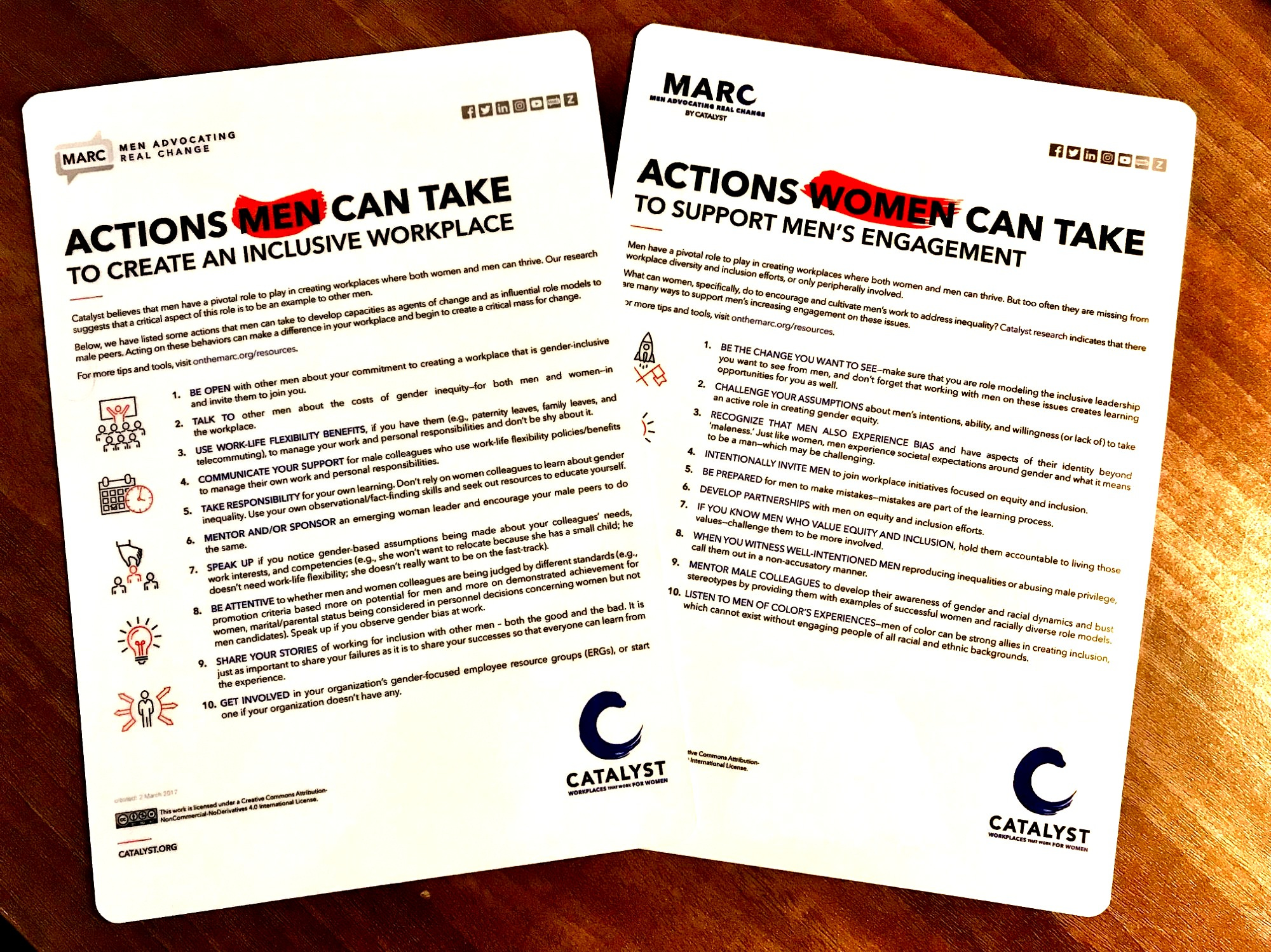
At a POWERful Women conference I handed out MARC by Catalyst cards: “Actions Men Can Take to Create an Inclusive Workplace”, and “Actions Women Can Take to Support Men’s Engagement”. We used them to run a round robin table discussion. The conversations they sparked were some of the most honest I have heard. MARC has since evolved. It now stands for Mutual Accountability, Real Change, reflecting a broader truth my research also points to: inclusion is not a task for women alone, or for men alone. It is a shared practice. You can find their resources at catalyst.org.
The women I mentor and sponsor give me confidence that the next generation of leaders is now at critical mass, and supporting one another more than ever before. This is absolutely vital because the energy transition needs the best talent, all of it.
INSIGHTS
My thesis conclusions still hold — and the business case has strengthened since 2018. McKinsey’s “Diversity Matters Even More” (2023) found that companies in the top quartile for board-gender diversity are 27% more likely to outperform financially, and those with diverse executive teams show a 39% increased likelihood of outperformance. MSCI’s 2024 research found that companies with 30% or more female directors saw 19% higher cumulative returns over the five years to 2024. The board representation numbers have improved: 62% with no women has fallen to 20%, and women CEOs have risen from 1% to 8%. But the 18%-to-5% drop in technical roles suggests we are still losing women at exactly the career stage where my research said companies should be investing most. This is in the mid-career years when caring responsibilities as mothers, looking after elderly parents, relatives with other needs, may reshape priorities. Too many talented women take the off-ramp.
The energy transition is creating opportunities that have grown dramatically since my 2018 research. Roles in grid digitalisation, carbon markets, hydrogen, battery storage, renewables and nature-based solutions have expanded enormously. Renewable energy employment alone reached 16.2 million globally in 2023 and is projected to double by 2030. Hydrogen has grown from a nascent sector to over 1.4 million jobs worldwide. Many of these roles value the cross-sector experience and systems thinking that women with non-linear careers bring naturally. Monica’s “squiggle” is becoming a competitive advantage, not a liability. The normalisation of flexible and hybrid working since the pandemic has also begun to address one of the biggest barriers my research identified: the balance between career and caring responsibilities. Women no longer have to choose between being present for their family and being always visible in the office. That is progress worth building on.
We have a rare chance to build new structures rather than simply reform old ones. My thesis ended with a quote from Mary Beard: “if women are not perceived to be fully within the structures of power, surely it is power that we need to redefine rather than women.” The companies and institutions being created now, such as in clean energy, in smart grid digitalisation, in climate finance, have the chance to design mentoring, sponsorship and culture into their foundations rather than retrofitting them. The question is whether we seize that chance. The women in my research already told us what they need. It is time that we listened.
Responsible Energy Briefing: When molecules can't move — goes deeper on the physical infrastructure chokepoints that sit beneath these investment risks. Free to read.
Career progression for women in the energy sector remains structurally impeded by a critical gap between professional needs and institutional provisions. Intersectional research spanning nearly a decade reveals that while formal mentorship and executive sponsorship are statistically the most valued mechanisms for advancement, women are routinely forced to rely on individual confidence-building as a survival mechanism in the absence of structured support. This reliance highlights a systemic pipeline failure, particularly in technical roles where female representation drops sharply from entry level to the executive tier.
The primary barrier is not a deficit in female resilience, but rather an exclusionary workplace culture characterized by informal networks and gendered evaluation standards. To achieve systemic equity, institutions must transition from generic diversity initiatives to intersectional career-stage tailored support, pairing active mentorship with male allyship to dismantle structural biases rather than merely coaching women to navigate them.